
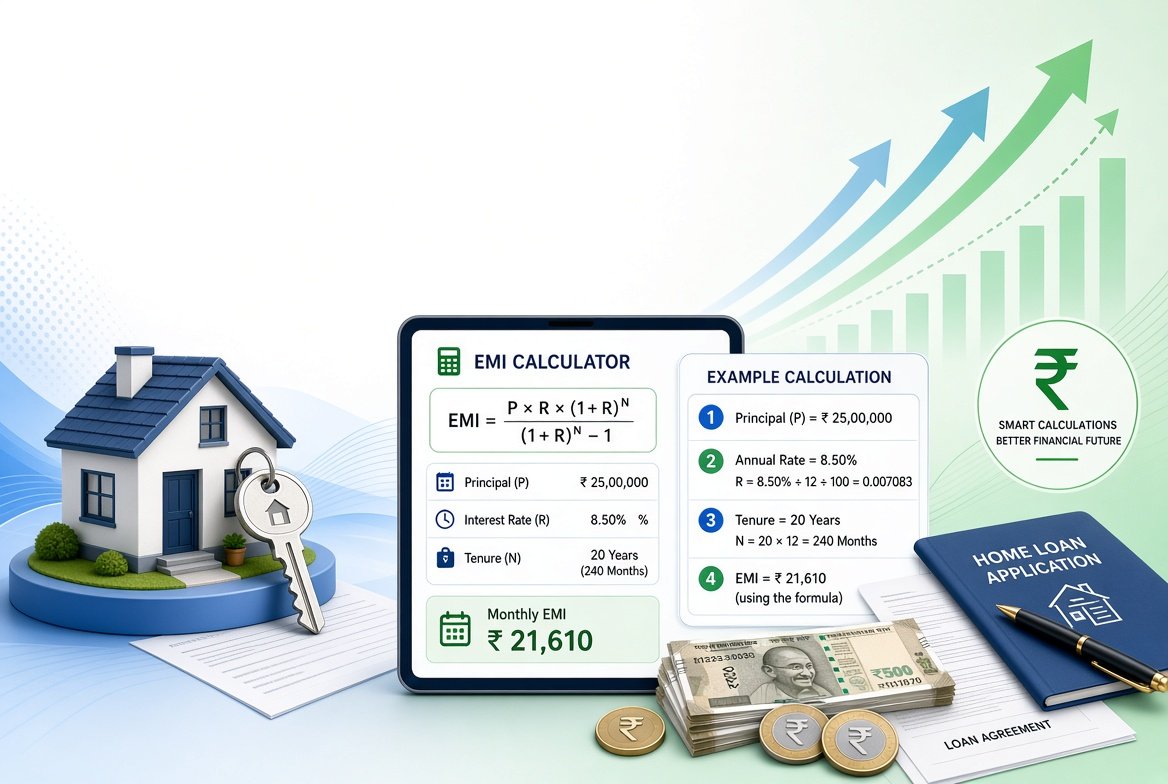
Your EMI (Equated Monthly Instalment) is the fixed amount you pay your bank every month until your home loan is finished. Before you sign a loan, you should know how much it will be and how it is calculated. The math is not hard, and once you understand it you can compare loans with confidence.
What is a home loan EMI?
Every EMI has two parts: interest and principal. In the early years, most of your EMI goes towards interest. Over time, the interest part shrinks and the principal part grows, while the total EMI stays the same.
Home loan EMI formula
EMI = P × r × (1 + r)n ÷ [(1 + r)n − 1]
- P = loan amount (principal)
- r = monthly interest rate (yearly rate ÷ 12 ÷ 100)
- n = number of monthly instalments (years × 12)
You do not need to do this by hand. Any EMI calculator uses this formula. But it helps to know what the numbers mean. Our article on why a home loan interest calculator is essential explains how to use one before you apply.
Example: a ₹30 lakh loan at 8.5% for 20 years
These rates are only for the example, not today’s offers.
- P = ₹30,00,000
- Yearly rate = 8.5%, so r = 8.5 ÷ 12 ÷ 100 = 0.007083
- n = 20 × 12 = 240 months
Your EMI comes to about ₹26,035 per month.
- Total you repay: about ₹62.48 lakh (₹26,035 × 240)
- Total interest: about ₹32.48 lakh
In the first month, around ₹21,250 of your EMI is interest and only about ₹4,785 reduces your loan. In the first year you pay about ₹2.53 lakh in interest and repay about ₹0.60 lakh of principal.
How interest rate and tenure change your EMI
All numbers below are for a ₹30 lakh loan.
| Interest rate | Tenure | Monthly EMI (approx.) | Total interest (approx.) |
|---|---|---|---|
| 8.5% | 15 years | ₹29,542 | ₹23.18 lakh |
| 8.5% | 20 years | ₹26,035 | ₹32.48 lakh |
| 8.5% | 25 years | ₹24,157 | ₹42.47 lakh |
| 8.5% | 30 years | ₹23,067 | ₹53.04 lakh |
| 9.0% | 20 years | ₹26,992 | ₹34.78 lakh |
Two things stand out:
- A longer tenure lowers your EMI but raises your total cost. Going from 20 to 30 years saves you about ₹3,000 a month, but adds around ₹20 lakh in interest.
- A small rise in the rate matters. Just 0.5% more adds about ₹2.3 lakh in interest over 20 years. Read more in our guide on how interest rates impact your total loan repayment.
Fixed vs floating rate
With a floating rate, your interest rate can go up or down as the lender’s rate changes. Your EMI or your tenure changes with it. With a fixed rate, the rate stays the same for the fixed period. Ask your lender which type applies and what happens when the rate changes.
How to reduce your home loan interest
- Make a bigger down payment. A smaller loan means less interest.
- Choose the shortest tenure you can afford. Pick an EMI that fits your budget without stress.
- Prepay when you have extra money. A part-payment goes straight to your principal.
- Compare lenders. A small difference in rate and fees adds up over many years.
- Improve your credit score first. A higher score can help you get a better rate. See our guide to checking your credit score for free.
Example: effect of a part-payment
Take the same ₹30 lakh, 8.5%, 20-year loan. After the first year, you still owe about ₹29.40 lakh. Suppose you prepay ₹2 lakh and keep paying the same EMI.
- Your loan ends in about 194 months instead of 229 months left, which is nearly 3 years early.
- You save roughly ₹6.9 lakh in interest.
Check with your lender about prepayment rules and charges. For floating-rate home loans taken by individuals, banks generally cannot charge a prepayment penalty, but terms vary, so confirm in writing.
How much EMI can you afford?
A common rule of thumb is to keep all your EMIs together at or below about 40% of your monthly take-home income. For example, if you take home ₹80,000, your total EMIs (home, car, personal loans) should ideally stay under ₹32,000. This is a guide, not a rule, so also keep money aside for emergencies.
Frequently asked questions
How is home loan EMI calculated?
It is calculated using the formula EMI = P × r × (1 + r)^n ÷ [(1 + r)^n − 1], where P is the loan amount, r is the monthly rate and n is the number of months.
What is the EMI for a ₹30 lakh loan for 20 years?
At an example rate of 8.5%, it is about ₹26,035 a month. At 9%, it is about ₹26,992 a month.
Does a longer tenure reduce the EMI?
Yes, but you pay much more interest in total.
Is it better to reduce EMI or tenure after a part-payment?
Reducing the tenure usually saves more interest. Reducing the EMI helps your monthly cash flow. Choose based on your budget.
Do EMIs change if the interest rate changes?
On a floating-rate loan, the lender may change either your EMI or your tenure when the rate changes. Ask your lender how it works.
Final thoughts
A home loan is a long commitment, so a few minutes of math before you sign can save lakhs of rupees. Compare at least two or three lenders, choose a tenure you can handle, and prepay when you can. For more guides, visit our Finance section.
Disclaimer: This article is for general information only and is not financial advice. All figures are examples. Actual rates, fees and terms depend on your lender and profile. Please check the loan documents and speak to your bank before you borrow. See our full disclaimer. For official guidance on borrowing, visit the RBI website.